 TOP
TOP


百八○°
菊地 寅祐
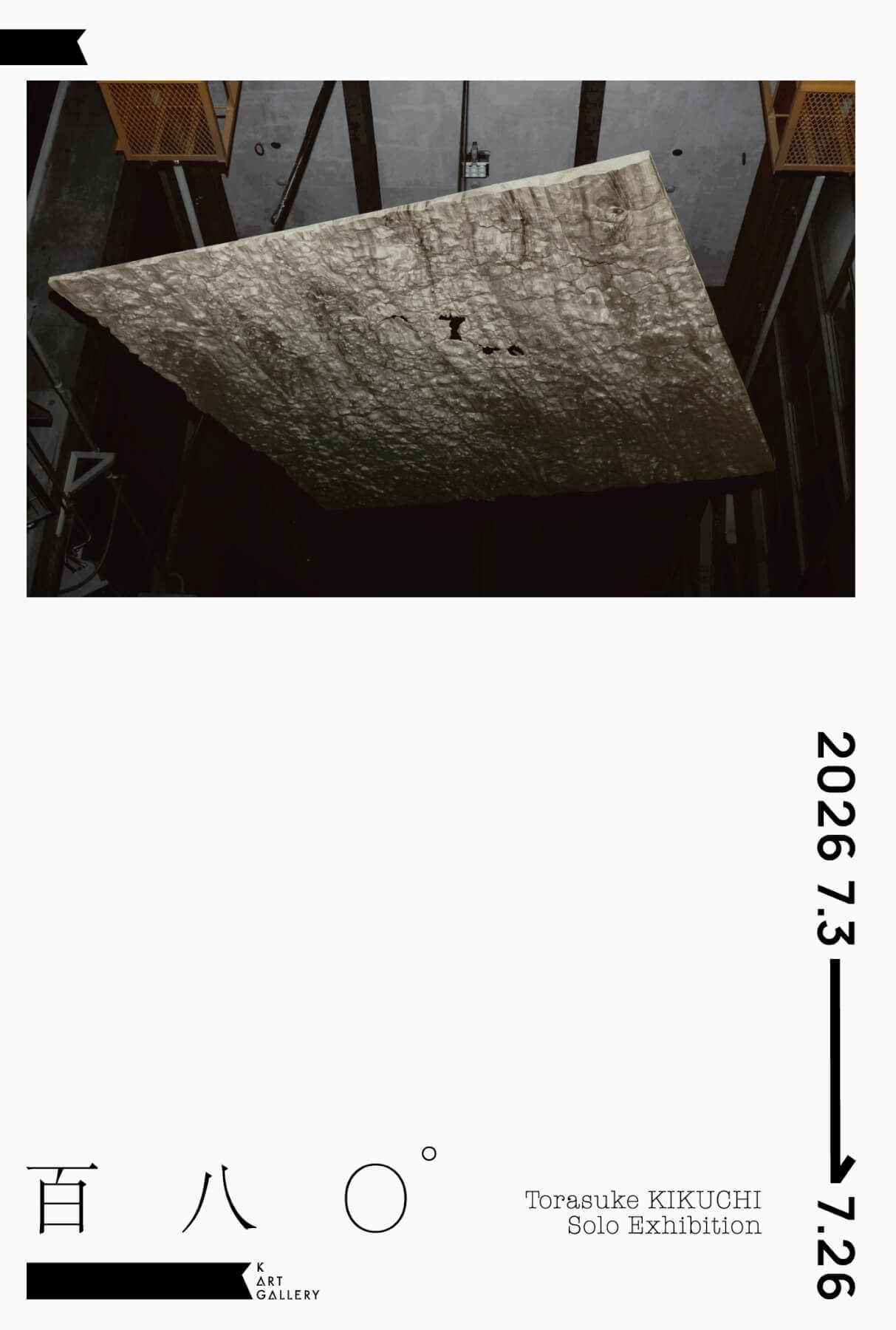
2026年7月3日(金)から7月26日(日)までK ART GALLERYにて、菊地 寅祐の個展、『百八○°』を開催いたします。
展示初日の7月3日はオープン時間を12:00-20:00に延長し、作家も在廊いたします。この機会にぜひお越しください。
-Artist Statement-
映画言語に、百八〇度規則と呼ばれるものがある。向き合う二人の役者を撮るとき、両者を結ぶ一本の境界線を引き、カメラを片側だけに置く。イマジナリーラインとも呼ばれるこの線を跨げば、二人の位置関係は崩れ、観客は物語から現実へと巻き戻される。菊地寅祐の木彫は、その線の向こう岸から始まる。
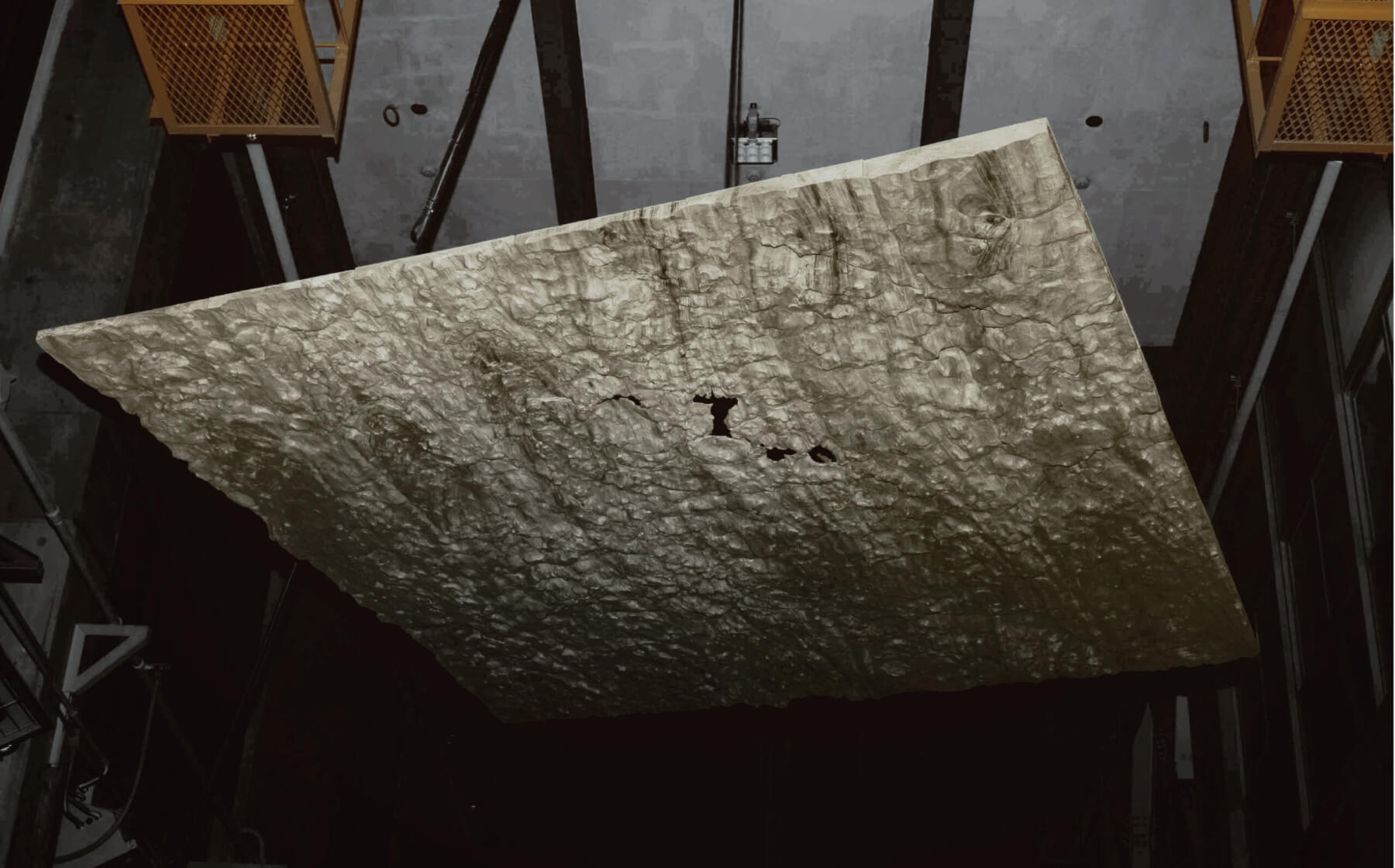
作品はすべて天井に固定されている。照明と配置によって、陰影もまた固定されている。一定の高さに留まる塊の下へ、我々は沈み込むようにして立ち入る。
形状は定まった輪郭から崩れ、溶けるような起伏を見せる。彫られているのは具象的なモチーフではない。図像が立ち上がる場(スクリーン)である。スクリーンとは、面でありながら、その上を像が時間とともに横切っていく場所だ。かつて、その時間は遡ることができた。VHSビデオデッキで再生し、巻き戻し、また再生する。
木の側にも、畳まれた時間がある。立っていた年月が、切り出された瞬間に断面へ晒される。乾かされ、鑿が入る。彫り進むほど、木の持つ別々の時間が同時に剥き出しになる。木彫とは、その時間を巻き戻す行為でもある。木にとっては、断片的な記憶を強制的にフラッシュバックさせられる経験。だがテープと違い、二度と同じ場所へは戻らない。手ブレした立体から、彫り進むほどにピントが定まってゆく。
菊地の作品は、彫刻でありながら編集に近い。一九七五年公開の映画『ジョーズ』に、船上の主人公の背後を流れ星がよぎるシーンがある。合成か、偶然の産物か。スクリーンを横断するそれに、観客は一瞬混乱する。物語に沈んでいた自分が、座席に座っている自分を見つけてしまう。継ぎ目とは、その瞬間のことだ。
菊地のつくる穴も、同じ継ぎ目にある。最後に現れるその穴を境に、造形は跨がれ、背景へと反転する。穴は頭上にある。木の塊は落ちることなく留まり、その下にいるのは見る者だけだ。そして、穴を見上げる。何が見えるかは、ここには示されていない。
(現代美術研究家 斉藤 勉)
参照作品
・
資料
スティーヴ・ブランドフォード/バリー・キース・グラント/ジム・ヒリアー
(杉野健太郎・中村裕英訳)
『フィルム・スタディーズ事典:映画・映像用語のすべて』
フィルムアート社、2004年
『ジョーズ』(監督:スティーヴン・スピルバーグ、1975年)
-Profile-
菊地 寅祐
1998年生。山梨県出身。
2025年 東京藝術大学 大学院美術研究科 彫刻専攻修士課程 修了。
現在、同大学教員研究助手として勤務。
【開催日時】2026年7月3日(金)- 7月26日(日)
【開館時間】12:00-18:00 (月曜、火曜休館)
【会場】K ART GALLERY
*7月3日(金)20時まで開廊時間を延長しています
*7月26日(日)は16時まで
- - - - -
One Hundred and Eight Zero°
Torasuke Kikuchi
July 3 (Fri) – July 26 (Sun), 2026
K ART GALLERY is pleased to present 180°, a solo exhibition by Torasuke Kikuchi, from Friday, July 3 to Sunday, July 26, 2026.
On the opening day, Friday, July 3, the gallery will remain open from 12:00 to 20:00, and the artist will be present. We warmly invite you to visit the exhibition.
-Artist Statement-
Cinema has a convention known as the 180-degree rule. An imaginary line is drawn behind the subject, and the camera must never cross it. As long as the rule is observed, cinematic space remains coherent, and the viewer is held within the narrative. The moment the line is crossed, both space and story begin to collapse, and the presence of the filmmaker, once hidden outside the frame, suddenly emerges. Tasuke Kikuchi’s wood sculptures begin from the far side of that line.
Kikuchi’s works compel the viewer to read forms into them. Their carved surfaces shift like rippling water, changing expression according to the angle of view and the fall of light. What appears within the shadows differs from one observer to another. What is carved is not a representational motif. Rather, it is the very screen upon which images come into being.
In the act of reading these forms, viewers inevitably summon their own memories. There was a time when moving images were not streamed, but rewound. We played a VHS tape, rewound it, and played it again. Searching for images within shifting shadows is much the same: each person rewinds their own tape and projects their own story. What appears there is not the image of the artist, but the image of the viewer.
While the viewer projects memories into the work, the wood itself also contains folded layers of time. The years it once spent standing as a tree are exposed the moment it is cut, revealed in its cross section. It is dried, then marked by the chisel. With every cut, different temporalities are laid bare at once. Wood carving becomes an act of rewinding that accumulated time. For the wood, it is as though fragmented memories are forcibly brought back in flashes. Yet unlike magnetic tape, it can never return to the same place twice. The more it is carved, the more form accumulates. But when the final opening appears, form itself turns inside out and becomes negative space.
Though Kikuchi’s work is sculpture, it is perhaps closer to editing. In Jaws, Steven Spielberg scratched directly onto the film stock itself to create a shooting star in the night sky. This technique, inscribing directly onto film without using a camera is known as cinecalligraphy, a practice associated with the traditions of non-camera and pure cinema. What seems like an accidental speck of dust is, in fact, the trace of a deliberate hand. Kikuchi’s apertures occupy that same threshold: a place where intention and forces beyond intention become impossible to distinguish.
Those openings are positioned overhead. Every work is suspended, and the viewer stands beneath them as though gazing upward from beneath the surface of the sea. The masses of wood remain suspended, never falling, and it is only the viewer who remains below.
And so we look up into the opening. Into something without fixed form, the viewer pours their own memories. What they will see is not prescribed here.
— Tsutomu Saito, Contemporary Art Researcher
References
Steve Blandford, Barry Keith Grant, and Jim Hillier, translated by Kentaro Sugano and Hirohide Nakamura, The Film Studies Dictionary: A Guide to the Language of Cinema and Media, Film Art Inc., 2004.
Jaws (dir. Steven Spielberg, 1975).
-Profile-
Born in 1998 in Yamanashi, Japan.
Completed the Master’s Program in Sculpture at the Graduate School of Fine Arts, Tokyo University of the Arts, in 2025.
Currently works as a Research Assistant at the same university.
Dates: July 3 (Fri) – July 26 (Sun), 2026
Hours: 12:00–18:00
Closed: Mondays and Tuesdays
Venue: K ART GALLERY
On Friday, July 3, the gallery will remain open until 20:00.
On Sunday, July 26, the gallery will close at 16:00.
Instagram:
yin5901